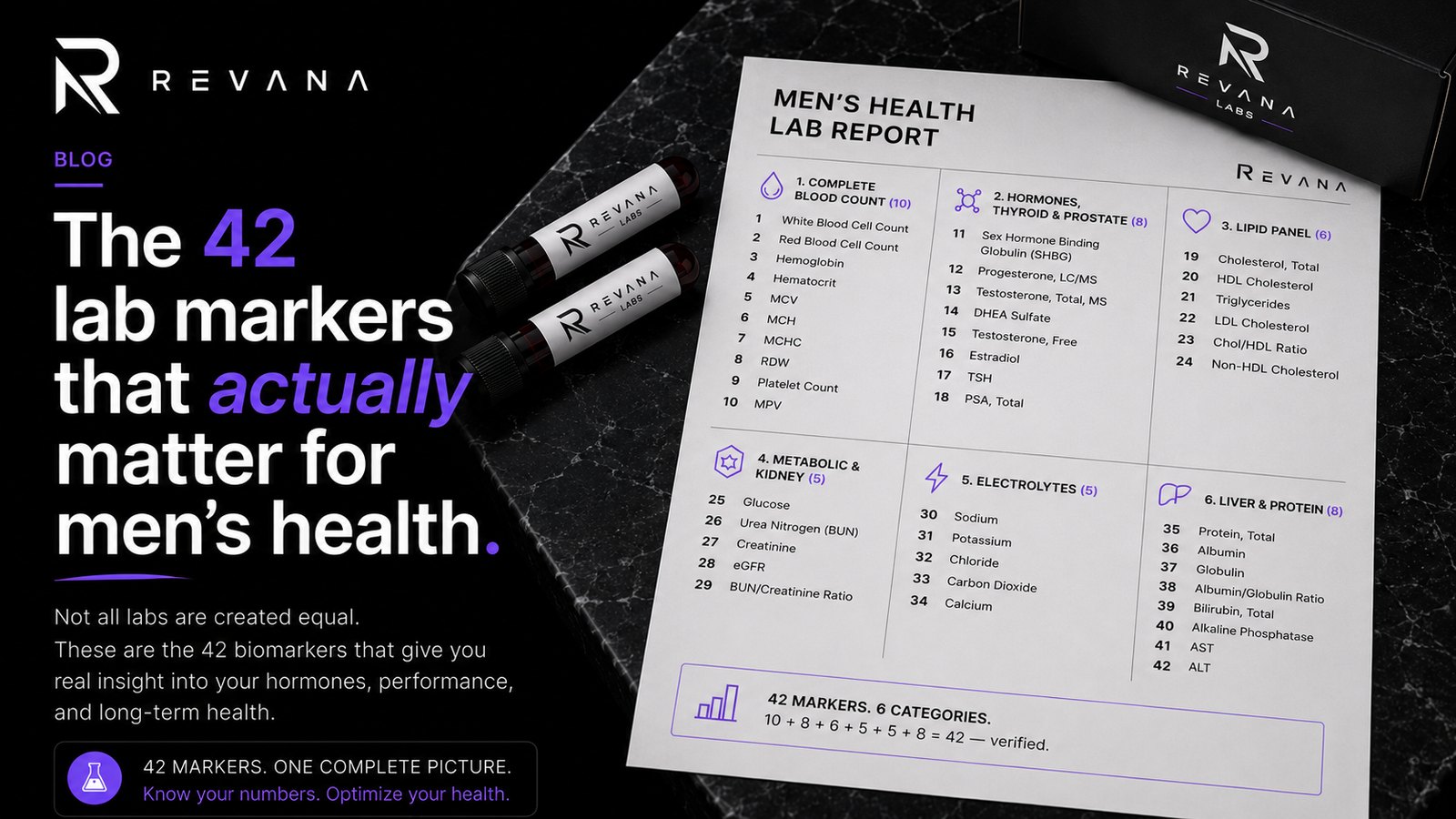
A single total-testosterone number cannot tell you why you feel the way you feel, and it cannot tell you whether therapy would be safe. A complete picture needs the hormone system in context: free and bound testosterone, estradiol, thyroid, blood counts, metabolic and lipid values, and the safety markers that responsible monitoring depends on.
Most men who finally get their testosterone checked receive one number back. Total testosterone. And with it, a verdict: you are in range.
That number is not wrong. It is just incomplete, in the way that judging a business by one line of its financials is incomplete. Here is what a thorough panel actually looks at, grouped the way a physician reads it, and why each group matters whether or not you ever start therapy.
1. The hormone core
Total testosterone counts all the testosterone in your blood. But most of it is bound to a protein called SHBG, short for sex hormone binding globulin, and bound testosterone is not available to your tissues. The small unbound fraction, free testosterone, is what actually does the work. This is why two men with identical totals can feel completely different. If one has high SHBG, his usable testosterone may be genuinely low even though his total looks fine.
Estradiol matters more in men than most people expect. Your body converts some testosterone into it naturally, and both too much and too little cause real symptoms. DHEA sulfate reads the adrenal side of your hormone production, and progesterone, measured by high-precision LC/MS, fills in a part of the picture most men never see tested. Together with total testosterone, free testosterone, and SHBG, these seven values describe your hormone system as a system, not a single number.
One honest note on scope. If this panel points to a problem upstream, in the brain rather than the testes, your physician can order the pituitary signals, LH and FSH, as a targeted follow-up. A good panel does not test everything imaginable. It tests enough to know what question to ask next.
2. Thyroid, the great impersonator
Fatigue. Low mood. Weight gain. Brain fog. Those are the classic low testosterone complaints, and they are also the classic thyroid complaints. TSH is the standard screening test for thyroid function, and it catches a problem testosterone would never fix. In clinic, treating testosterone while missing an underactive thyroid is one of the most common failures of one-number medicine. If TSH comes back abnormal, that becomes its own workup with your physician.
3. Blood counts, the safety foundation
A complete blood count earns its place twice. Before therapy, it sets your baseline. During therapy, it becomes the key safety monitor. Testosterone stimulates red blood cell production, and if hematocrit climbs too high, the blood becomes thicker than it should be. Responsible protocols track this on a schedule, not on a hunch. If you have been on TRT for a year and no one has rechecked your hematocrit, that is worth acting on.
4. Metabolic health
Glucose is the front door of metabolic health, and metabolic dysfunction both mimics low testosterone and makes it worse. The two travel together often enough that finding one should always prompt a look at the other. Around it sits a full metabolic and kidney panel: BUN, creatinine, eGFR, and their ratio, plus the electrolytes your physiology runs on. These are the organs and systems any long-term therapy depends on, measured before anyone writes a prescription.
5. Lipids and cardiovascular context
A full lipid panel belongs in any baseline: total cholesterol, HDL, LDL, triglycerides, and the ratios that put them in context. Cardiovascular health is the backdrop for every hormone decision, and repeat panels show what therapy is actually doing in your body over time, rather than in a study population. Alongside it, liver and protein values, including AST, ALT, albumin, and bilirubin, confirm the organ every medication passes through is ready for the job.
6. Prostate baseline
PSA is a pre-treatment essential for appropriate candidates and a monitoring value afterward. Prostate context is simply part of prescribing testosterone responsibly.
Why breadth beats a retest
Here is the pattern across all six groups. Any single value can mislead you. The pattern rarely does. Symptoms plus a low-normal total, low free testosterone, high SHBG, and quiet LH tell one story. The same symptoms with clean hormones and an abnormal TSH tell a completely different one. The panel is not 42 markers for the sake of a big number. It is the minimum context in which a hormone decision is honest.
It is also a filter for clinics. An operation willing to prescribe from a single total-testosterone draw is telling you how the rest of the relationship will go.
Get the full picture. 42 markers, one draw.
Revana's assessment starts with a comprehensive lab panel read by a board-certified physician. It costs $119, and that is the only cost unless you choose to begin treatment.
Check My Levels →One number told you that you are fine. Forty-two will tell you what is actually happening. Sometimes the most valuable result on the page is the one showing that testosterone was never your problem.