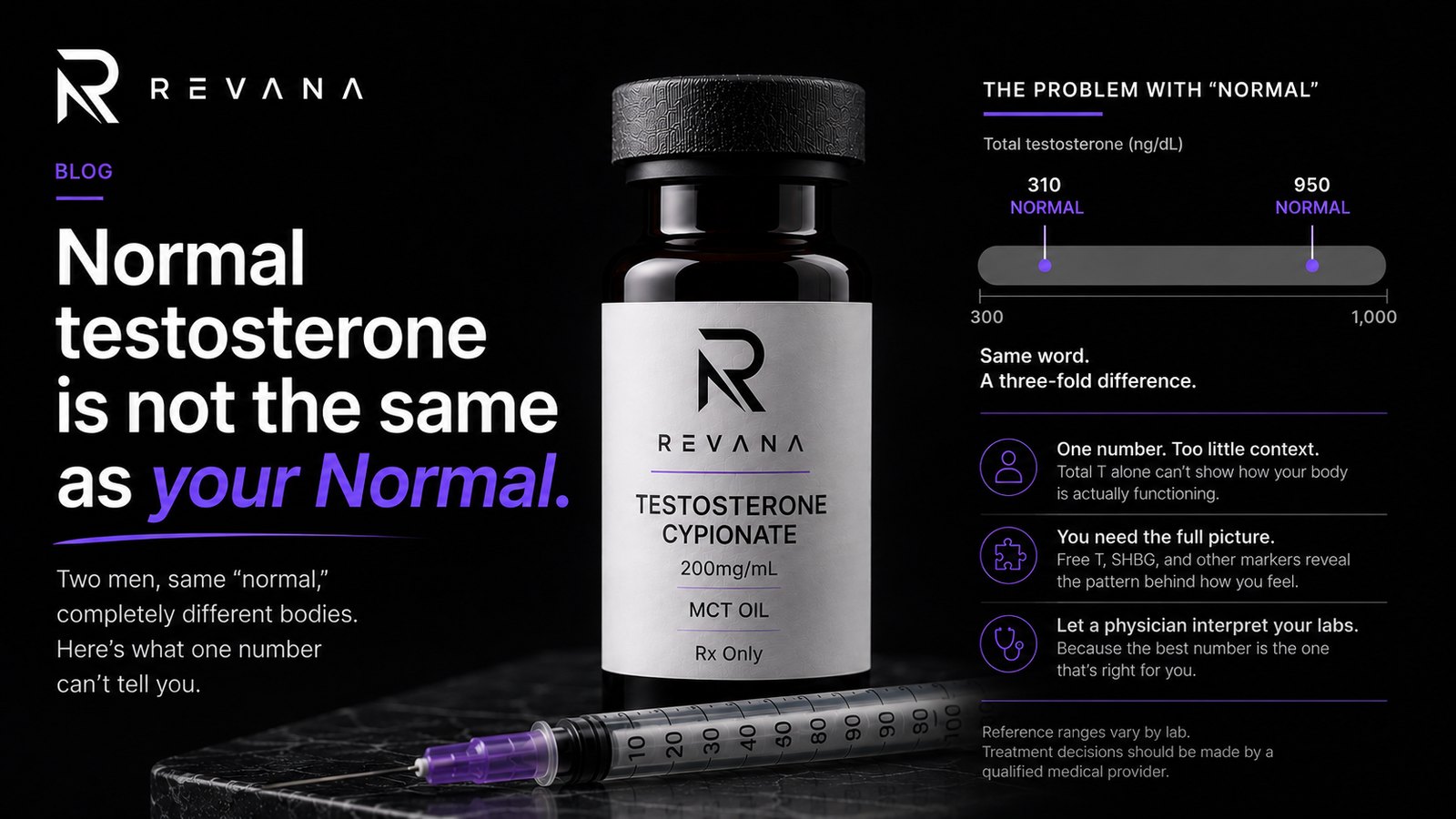
Lab reference ranges for testosterone are statistical spans built from broad populations. They are not verdicts about your health. A result can sit in range while free testosterone, SHBG, and your symptoms tell a different story. Where you land in the range is where the conversation starts, not where it ends.
It may be the most common sentence in men’s health: your labs are normal. It lands with the finality of a court ruling, and every year it convinces millions of men that the fatigue, the missing drive, and the mental fog must be something else. Age. Stress. A personal failing.
But the word normal has a technical meaning on a lab report, and most patients are never told what it is.
What a reference range actually is
When a laboratory prints a testosterone range, commonly somewhere near 300 to 1,000 ng/dL for total testosterone depending on the lab, that range is statistical. It describes where roughly 95 percent of a reference population landed. It was never designed to answer the question that actually matters: is this level right for this man, with these symptoms, at this age?
Consider how wide that span is. A man at 310 and a man at 950 both get the same one-word summary. Normal. Yet their hormonal environments differ by a factor of three. Both may truly be fine. Or the man at 310 may have lost half of his lifelong baseline and feels every bit of it. The lab report cannot tell those two cases apart. Only context can.
Total versus free, the distinction that changes stories
Total testosterone counts everything in your blood, including the large share bound to SHBG and unavailable to your tissues. The unbound portion, free testosterone, is what your body can actually use, and it is a small percentage of the total.
This is where normal most often breaks down. SHBG tends to rise with age, and with certain conditions and medications. As it rises, it locks up a growing share of your testosterone. The result is a total that looks respectable sitting on top of a free level that is genuinely low. On a one-number panel, that man is fine. In his own life, he is not. Measuring free testosterone and SHBG together is how that gap gets caught, which is why a panel that skips them cannot honestly clear you.
Symptoms are data too
Good medicine does not treat a number in isolation, in either direction. Clinical guidelines for diagnosing testosterone deficiency consistently require both consistent symptoms and confirmed low measurements, usually including repeat morning draws, because testosterone moves with time of day, sleep, and illness. One low afternoon reading is not a diagnosis. Neither is one normal one.
The practical point: fatigue, low libido, low mood, poor concentration, and a changing body are findings a physician should weigh alongside the labs. They are not complaints to dismiss the moment a single number clears 300.
What to do with a normal result you do not believe
- Ask what was measured. If free testosterone and SHBG were not on the panel, the picture is incomplete by construction.
- Ask when it was drawn. Morning draws are the standard for a reason. Afternoon values read lower.
- Ask for the context markers. Thyroid, metabolic values, and blood counts rule out the conditions that mimic low testosterone. They deserve to be checked, not assumed away.
- Get your actual numbers, not the summary word. You are entitled to your values, and a trend over time beats any single snapshot.
And honesty cuts both ways. Sometimes the full panel comes back and testosterone genuinely is not your problem. That is not a failure. That is the system working. A physician who tells you no from complete data has done you a bigger favor than one who says yes from a single number.
Get the full picture. 42 markers, one draw.
Revana's assessment starts with a comprehensive lab panel read by a board-certified physician. It costs $119, and that is the only cost unless you choose to begin treatment.
Check My Levels →Normal describes a population. You are not a population. Get the whole picture, put a physician in front of it, and decide from evidence, whichever way it points.